
Phone:

Genevix Equipments supplies semi automated and fully automated urine analysers to diagnostic labs, hospitals and clinics across India. The range runs from single bench strip readers to AI assisted systems that image sediment, covering 14 to 18 parameters and up to 600 tests per hour. Every analyser is installed, calibrated and serviced by our own engineers, and carries a 24 month warranty with six preventive maintenance visits included.
Most urinalysis purchases go wrong in the same way. The lab compares machine prices, picks the cheaper one, and finds out eighteen months later that the strips cost twice as much and only one supplier sells them. We would rather have that conversation before you buy than after, which is why there is a cost per test section further down this page and a strip supply section after it.
| Models supplied | AimStrip Urine Analyzer 2, URIT-560, UC-58, US-500 AI-Libre |
| Parameter range | 10 to 18 parameters depending on model and strip |
| Throughput | Up to 600 tests per hour |
| Sediment analysis | Available on the US-500 AI-Libre |
| Connectivity | RS232, USB, LIS, with WiFi and Bluetooth optional on the UC-58 |
| Warranty | 24 months on new equipment |
| Preventive maintenance | 6 free PPM, scheduled by us |
| Installation and training | Included, by our own engineers |
| Strips and consumables | Stocked, dispatched within one working day |
| Coverage | Across India, with an engineer travelling for installation |
| Supplier | Genevix Equipments India Private Limited, Coimbatore, ISO 9001:2015 |
Three models, chosen to cover the range from a clinic doing twenty samples a day to a hospital lab that needs sediment imaging alongside dry chemistry.
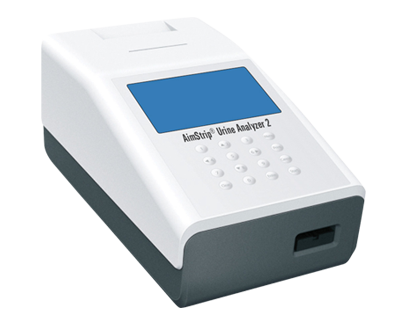
A compact strip reader built for clinics and collection centres. One touch testing, so a technician dips, places and reads with no menu navigation, which matters when the person running it is not a full time lab technologist. It holds 2,000 results and connects over USB to a LIS. CLIA waived, which tells you it was designed to be operated safely outside a full laboratory setting.
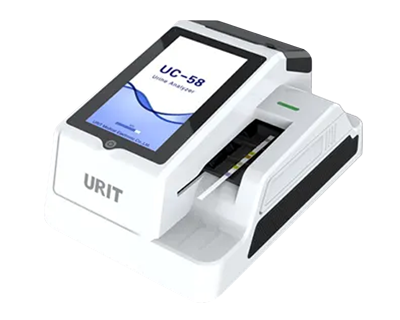
Eighteen parameters, 550 tests per hour, 45 second reaction time and a 20,000 result memory on a 7 inch colour touchscreen. Five wavelength reflectance photometry. RS232 and a USB barcode reader as standard, with WiFi and Bluetooth available.
Two things about this analyser are worth knowing because almost nobody publishes them.
It runs on a 12V DC integrated lithium battery and will complete more than 600 tests with no mains supply at all. If you run camps, a mobile health unit, or a collection point somewhere the power is unreliable, that changes what is possible.
And its constant temperature control system holds accuracy down to 5°C room temperature. Strip chemistry is temperature sensitive, and a cold morning in an unheated lab will skew results on an analyser that does not compensate. This one does.
At 308 by 210 by 151 mm and 3 kg it is also light enough to carry.
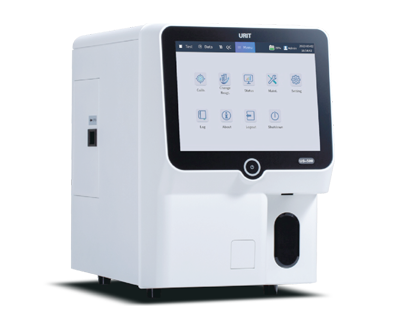
Dry chemistry and sediment analysis in one system, running dual channel with full field imaging of the sediment. This is the model for labs that currently do chemistry on an analyser and sediment under a microscope, and want to stop moving the sample between two benches and two technicians.
| Model | Parameters | Throughput | Memory | Sediment | Best suited to |
|---|---|---|---|---|---|
| AimStrip Urine Analyzer 2 | Strip based, CLIA waived | One touch testing | 2,000 results | No | Clinics, collection centres |
| UC-58 | 18 including PCR, colour, turbidity | 550 tests per hour | 20,000 results | No | Full reporting, battery operation |
| US-500 AI-Libre | Chemistry plus sediment | Dual channel | Per configuration | Yes | Hospital labs, complete urinalysis |
No obligation. We reply within one working day.
On a semi automatic analyser, a technician dips the strip, places it on the reading bed and the machine does the rest. On a fully automatic system, strip feeding, reading and disposal are handled by the machine, and the better systems add sediment imaging so chemistry and microscopy happen in one pass.
The difference is not accuracy. Both read the same strip chemistry with the same photometry. The difference is technician time, and whether a person has to stand at the bench while samples are processed.
Below roughly 150 samples a day, a semi automatic analyser is the right buy and the extra spend on automation is hard to justify. Between 150 and 300, it depends on whether that volume arrives spread through the day or in a two hour peak after collection. Above 300, or if you report sediment on most samples, full automation pays for itself in technician hours rather than in test cost.
The honest version is that most labs in India buying their first or second analyser are well served by a semi automatic unit, and a supplier who pushes automation at a 60 sample a day lab is selling rather than advising.
Send us a week of sample counts and we will work it out with you.
Parameter count is the specification buyers compare most and understand least. Here is what each step up actually adds.
| Strip | Parameters covered | What the step up gives you |
|---|---|---|
| 10 parameter | Glucose, protein, pH, blood, ketones, bilirubin, urobilinogen, nitrite, leukocytes, specific gravity | Covers routine outpatient urinalysis and UTI screening |
| 11 parameter | The above plus ascorbic acid | Ascorbic acid flags vitamin C interference, which causes false negatives on glucose and blood |
| 14 to 15 parameter | The above plus microalbumin, creatinine, albumin to creatinine ratio, calcium | Early kidney disease screening, which is why diabetic care centres specify this level |
| 18 parameter | The above plus protein to creatinine ratio, colour and turbidity | PCR for proteinuria assessment, and physical examination reported by the machine rather than by eye |
Microalbumin and the albumin to creatinine ratio. A raised albumin level on its own is hard to interpret because urine concentration varies through the day. The ratio corrects for that, which is why nephrology guidance is written around ACR rather than albumin alone. If your lab serves a diabetic clinic or a nephrology practice, a 10 parameter strip will not be enough, however good the analyser reading it.
Not strictly. Both are traditionally reported by visual inspection. Having the analyser read them removes an inter observer variable and means the physical examination and the chemistry come off one instrument onto one report. For a lab chasing consistency across shifts, it is worth having. For a two person clinic lab, it is a nice to have.
The cost depends on the type of analyzer (semi automatic or fully automated), parameter count, throughput, sediment imaging and connectivity. A compact semi automatic model suits a small lab or clinic, while a fully automated system with sediment imaging suits high volume work.
We will quote a figure once we know your volume and your reporting requirement, and we will tell you where a simpler model would do the same job.
On a urine analyzer the running cost is the strip, because urine chemistry uses no separate reagent.
That cost deserves more attention than it usually gets. A lab running 80 samples a day uses about 1,760 strips a month, so even a small difference in strip price adds up quickly over a year. The gap between two analyzers on strip cost will often exceed the gap between their purchase prices well before the warranty runs out.
So when you compare quotes, ask every supplier for the machine price and the strip price together. A low quote on the machine is frequently recovered on the strip, and by then you are committed to the format.
We stock strips, liquid controls and printer paper for every analyser we sell. Orders are usually dispatched within one working day and couriered anywhere in India.
Strip continuity is the thing to check before you buy any analyser, from anyone. If the strip is available from a single source and that source changes its India distribution, your machine becomes an expensive paperweight. We will tell you plainly which of our models take a widely available strip and which are tied to one supply chain, before you order rather than after.
Yes, anywhere in India, usually dispatched within one working day. We recommend holding a minimum stock level so testing never waits on a courier, and we will suggest what that level should be based on your daily volume and your location.
Every analyser we supply offers output to a laboratory information system. The URIT-560 provides RS232, parallel and USB. The UC-58 adds a USB barcode reader as standard, with WiFi and Bluetooth optional. The AimStrip 2 connects over USB.
What a datasheet will not tell you is whether the machine will actually talk to the software your lab already runs, and who fixes it if it does not.
We build LabsGene, our own laboratory information system. It fetches results directly from the analyser rather than having a technician retype them, which removes the step where most reporting errors enter. If you already run an LIS or HIS, we integrate with that instead, using FHIR based data exchange.
Usually yes, and we confirm it before you order rather than after. Tell us which system you run and we will check compatibility, tell you what connects directly, what needs a bridge and what it takes to set up. This is the part most equipment suppliers cannot answer, because dealers do not build software and software vendors do not supply analysers, so integration becomes an argument between two companies while your lab waits.
Installation by our own engineer. We install, calibrate, run control strips to confirm the readings and hand over the calibration documentation and the manual.
On site technician training. We train your staff until they can run the analyser unsupervised. Daily operation, cleaning the optical sensor, changing printer paper, recognising a drifting control before it becomes a failed QC run.
24 month warranty. The standard in this market is twelve months. Ours is twenty four, covering manufacturing defects and parts. Strips, controls and printer paper are excluded, as is damage from power fluctuation, which is why we recommend a stabiliser on every analyser we install. Physical and water damages will not cover.
Six free preventive maintenance visits. We schedule them. You do not have to call and ask. On urine analysers most problems start as optical sensor contamination or calibration drift, both of which are a five minute fix on a scheduled visit and a lost reporting day if nobody is looking.
Equipment exchange. We renovate and take in old equipment. Send photographs and the model number of what you are replacing and we will tell you what it is worth against a new purchase before you commit to anything.
We are based in Coimbatore, Tamil Nadu, and we supply nationwide. Equipment is packed for transit, insured and shipped on a GST invoice. For most installations our engineer travels to site, installs, calibrates and trains your technicians, and we quote that cost upfront so there is no surprise on the final bill.
Yes, to most states in India. Delivery is typically around 15 working days to South India, around 15 working days to West and Central India and around 15 working days to the North and North East. Strips and consumables are couriered anywhere in the country, usually dispatched within one working day.