
Phone:

Genevix Equipments is one of the hematology analyzer suppliers in India, supplying 3 part, 5 part and 6 part automated analyzers and cartridge based point of care models to diagnostic labs, hospitals and clinics. The range covers everything from a 20 µL fingertip CBC in four minutes to a 6 part analyzer reporting reticulocytes. Every analyzer is installed, calibrated and serviced by our own engineers, and carries a 24 month warranty with six preventive maintenance visits included.
Most hematology purchases are decided on machine price and regretted on reagent cost. A 5 part analyzer that looks affordable can run expensive per CBC, and a closed reagent system ties that cost to one supplier for as long as you own the machine. We would rather put those numbers in front of you before you buy, which is why the cost per test and reagent sections sit further down this page.
| Models supplied | BHA-3000, BHA-5000, MX5200, DH-615, PB30, Dymind DP-H10 |
| Differential range | 3 part, 5 part and 6 part with reticulocytes |
| Point of care | CBC with CRP and SAA on a single cartridge, 20 µL fingertip sample |
| Sample volume | From 6 µL venous blood on the BHA-3000 |
| Result storage | 10,000 to 300,000 results depending on model |
| Connectivity | Bi-directional LIS on the MX5200 and DP-H10, USB on all models |
| Warranty | 24 months on new equipment |
| Preventive maintenance | 6 visits, free, scheduled by us |
| Supplier | Genevix Equipments India Private Limited, Coimbatore, ISO 9001:2015 |
Six models, chosen so that a clinic running ten CBCs a day and a hospital lab running anaemia workups both have a sensible option. Specifications below are taken from the manufacturer datasheets.

A 3 part analyzer reporting 21 parameters at 60 samples an hour, using electrical impedance for cell counting and colorimetry for hemoglobin. It needs only 6 µL of venous blood, or 20 µL of capillary blood in pre-dilution mode, which matters for paediatric and elderly patients where a full draw is difficult.
It runs on one diluent and one lyse, stores 10,000 results and supports L-J and X-B quality control. The 10.4 inch screen and built in printer mean it needs no external computer.

A 5 part analyzer reporting 25 parameters with two histograms and two scattergrams. White cells are classified by laser based flow cytometry across a dual channel, while red cells and platelets are counted by impedance.
It runs at 60 tests an hour on 15 µL per test and stores 100,000 results. Automatic cleaning, anti-clogging and back flushing are built in, and the manufacturer states zero reagent residue through patented volume detection.

A 5 part analyzer reporting 25 parameters plus 6 research parameters, including atypical lymphocytes and nucleated red cells. It runs at 60 samples an hour, with an emergency sample priority function and several sample injection modes designed to extend unattended running time.
The 13.3 inch touch screen, 100,000 result memory and bi-directional LIS over USB and LAN make it the most connected of the 5 part models.

Dymind's 6 part analyzer reports 35 parameters and 29 research parameters, adding immature granulocytes and the full reticulocyte panel: RET%, RET#, IRF, LFR, MFR and HFR. It uses fluorescent nucleic acid staining with laser scatter and flow cytometry.
When an abnormal platelet histogram appears it switches automatically from the impedance channel to the optical channel, correcting for microcytes and platelet clumping. Abnormal samples are re-run automatically, and two units can be linked into a single workstation.

A point of care 3 part analyzer that runs CBC, CBC with CRP, CBC with SAA, or all three together, from a single reagent free cartridge. It needs 20 µL of fingertip blood and returns a result in about four minutes.
It reports 21 CBC parameters plus CRP, hs-CRP and SAA, stores 200,000 results and connects over USB, HDMI and WiFi. At 9.8 kg it is easy to place in a consulting room.
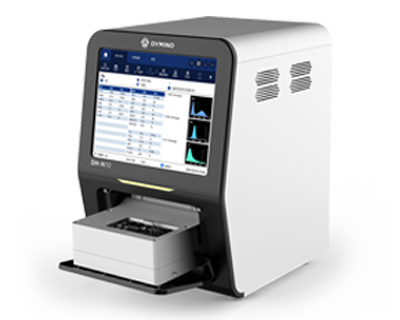
The first point of care hematology analyzer to use single test cartridges instead of reagent bottles. Cartridges store at room temperature with a 24 month shelf life, no reagent or blood moves through the analyzer, and the manufacturer states it requires no maintenance.
It runs CBC with CRP and SAA on one cartridge from a 20 µL sample, with results in about four minutes, stores 300,000 results and supports bi-directional LIS. If you have ever thrown away half a bottle of reagent because the open bottle expired first, this is the analyzer that removes the problem.
| Model | Differential | Parameters | Throughput | Sample | Memory |
|---|---|---|---|---|---|
| BHA-3000 | 3 part | 21 | 60 per hour | 6 µL venous | 10,000 |
| PB30 | 3 part POCT + CRP + SAA | 21 + 3 protein | 18 per hour | 20 µL fingertip | 200,000 |
| Dymind DP-H10 | 3 part POCT + CRP + SAA | 21 + 1 protein | 4 minutes per test | 20 µL | 300,000 |
| BHA-5000 | 5 part | 25 | 60 per hour | 15 µL | 100,000 |
| MX5200 | 5 part | 25 + 6 research | 60 per hour | 15 µL | 100,000 |
| DH-615 | 6 part with RET | 35 + 29 research | On request | Low volume | On request |
We will tell you which of these six fits, and which would be money spent on parameters you never use.
A 3 part hematology analyzer separates white cells into three groups: lymphocytes, mid-size cells and granulocytes. Monocytes, eosinophils and basophils are counted together inside the mid group. A 5 part hematology analyzer reports neutrophils, lymphocytes, monocytes, eosinophils and basophils separately, usually using laser light scatter rather than impedance alone.
The practical difference is what happens with an abnormal differential. On a 3 part analyzer, a raised mid cell count sends the slide to the microscope to find out which cell is responsible. On a 5 part analyzer the machine has already told you.
When your lab evaluates anaemia beyond the red cell indices, follows patients on chemotherapy, or monitors bone marrow recovery after transplant. Reticulocyte count and the immature reticulocyte fraction tell you whether the marrow is responding, which a standard CBC cannot. If your lab sends reticulocyte counts out today, a 6 part analyzer brings them in house.
| Differential | White cell groups reported | What the step up gives you | Typical lab |
|---|---|---|---|
| 3 part | Lymphocytes, mid cells, granulocytes | Routine CBC at the lowest cost per test | Collection centres, clinics, small labs |
| 5 part | Neutrophils, lymphocytes, monocytes, eosinophils, basophils | Fewer manual smears, eosinophil and basophil counts reported directly | Pathology labs, hospital labs |
| 6 part with RET | Five part plus immature granulocytes, plus reticulocyte panel | Anaemia evaluation and marrow response in house | Hospital labs, oncology, hematology referral |
A simple rule we use with customers: under about 40 CBCs a day, a 3 part analyzer is usually the right buy and costs less per test. Above roughly 100 a day, or if you report full differentials, the 5 part pays for itself in smears you no longer read by hand. The 6 part is a clinical decision rather than a volume decision.
Yes. The PB30 and the Dymind DP-H10 both run CBC, CRP and SAA from one cartridge and one 20 µL sample, with a result in about four minutes. CRP rises strongly in bacterial infection, while SAA rises in both bacterial and viral infection, so reading them alongside the white cell count helps a clinician decide during the consultation whether antibiotics are likely to help.
A cartridge based hematology analyzer runs each test in a sealed single use cartridge that already contains the reagents. Nothing is pumped through the analyzer, so there are no reagent lines to clean, no open bottle expiry and no carry over between samples. The trade off is a higher cost per test than a bottle based analyzer running at volume, which is why cartridge systems suit clinics and wards rather than busy central labs.
Ask us what a point of care CBC with CRP would cost per patient at your volume.
The cost depends on the analyzer type and what you report. 3 part analyzers suit basic CBC work. 5 part analyzers add a full white cell differential, and 6 part analyzers with reticulocytes sit above that. Point of care cartridge analyzers are priced differently again, because more of the cost sits in the cartridge than in the machine. We will quote a figure once we know your volume and what you report.
On the bottle based analyzers we supply, the running cost is reagent per CBC. A 5 part analyzer costs more per test than a 3 part, because the differential uses additional lyse. On cartridge systems the cost is one cartridge per test, with no wastage from expiry.
A lab running 60 CBCs a day on a 5 part analyzer uses around 1,800 tests a month. That is a reagent bill every month, before controls and calibrators, and over three years it is often larger than the price difference between two machines. So ask every supplier for the machine price and the cost per CBC together.
Work it out from three numbers: what you charge a patient for a CBC, your reagent cost per CBC, and how many CBCs you run a day. The difference between the first two, multiplied by your daily volume, is what the analyzer earns before staff and rent. Divide the analyzer price by that monthly figure and you have the payback period in months. Send us your own numbers and we will run the calculation for each model you are considering.
For the models that actually suit your volume, not the most expensive one on the list.
 Hospitals & Clinics
 Pathology Labs
 Diagnostic Centres
 Emergency Departments
 Research Institutions
 Community Health Centres
Send us a photo of the room and we will tell you what it needs before delivery: power, space and temperature.
The MX5200 and the DP-H10 support bi-directional LIS, so orders go to the analyzer and results come back without anyone typing them. The PB30 connects over USB, HDMI, WiFi and WLAN, and every model in the range supports USB export.
We build LabsGene, our own laboratory information system. It fetches results directly from the analyzer, removing the manual entry step where most reporting errors are introduced, and exchanges data over FHIR so it connects to hospital systems rather than sitting in a silo. If you already run an LIS or HIS, we integrate with it instead.
Usually yes, and we confirm it before you order. Tell us which system you run and we will tell you what connects directly and what needs a bridge. Most equipment dealers cannot answer this question, because dealers do not build software and software vendors do not supply analyzers. We do both.
We will confirm compatibility before you commit to a machine, not after it arrives.
The market standard is twelve months. Ours is twenty four, covering manufacturing defects and parts. Reagents, controls and power fluctuation damage are excluded, which is why we recommend a stabiliser or UPS on every installation.
We schedule them without waiting for you to call. Most hematology faults begin as aperture clogging, calibration drift or a reagent issue, and a scheduled visit catches them before they cost a reporting day.
We install the analyzer, calibrate it, run controls to confirm the readings, and hand over the calibration records.
Daily start up and shutdown, running L-J quality control, reading scattergrams and histograms, and recognising an abnormal sample flag before it reaches a report.
Setting up a new lab or clinic? We support the setup end to end, from choosing the analyzer to installation and training.
Send photographs and the model number of the analyzer you are replacing, and we will tell you what it is worth against a new purchase.
Speak to them before you buy, not after something goes wrong.
Call +91 88078 48106We are based in Coimbatore, Tamil Nadu, and we supply hematology analyzers nationwide. Equipment is packed for transit, insured and shipped on a GST invoice. For most installations our engineer travels to site, installs, calibrates and trains your technicians, and we quote that cost upfront.
Yes, to most states in India. Delivery is typically around 15 working days to South India, 15 working days to West and Central India and 15 working days to the North and North East. Reagents, controls and cartridges are couriered anywhere in the country.
We will confirm delivery time and installation cost before you enquire any further.
Ask it directly. You will get an answer from someone who knows the equipment, not a form response.
Ask on WhatsApp